

Deciding what to do with an unwanted mobile home is rarely a simple choice. For many property owners, the structure has outlived its usefulness, yet it still holds potential value. The decision often boils down to a direct comparison: should you sell the unit privately or donate it to a qualified nonprofit? The answer depends heavily on your immediate goals, whether that is maximizing cash flow, eliminating liability, or securing a tax benefit. According to recent industry data, over 20 million manufactured homes exist in the United States, yet a significant percentage sit vacant or deteriorating on private land. Understanding the financial and logistical differences between these two paths is critical for making an informed decision. (Contact Us Banyan Mobile)
Financial Outcomes: Cash vs. Tax Deductions
The most immediate difference between selling and donating lies in the nature of the compensation you receive. When you choose to sell, you are engaging in a market transaction. You list the home, negotiate with buyers, and receive a lump sum of cash. This cash can be used immediately to pay off debts, cover property taxes, or fund new construction. (Free Mobile Home Removal)
However, selling a mobile home is rarely as straightforward as selling a site-built house. The value is heavily dependent on the age, condition, and location of the unit. Older models, particularly those built before 1976, may have little to no resale value due to outdated construction standards. Even newer homes can depreciate rapidly once they are detached from their foundation. In many cases, the cost of marketing and closing the sale can eat up a significant portion of the profit. (Insights amp Advice for)
On the other hand, donating your mobile home offers a different type of financial benefit: a charitable tax deduction. When you donate to an accredited 501(c)(3) organization like Banyan Mobile Home Removal, you are not receiving cash. Instead, you receive a deduction based on the fair market value of the home at the time of donation. This deduction can lower your taxable income, effectively saving you money on your tax bill.
For many homeowners, the tax deduction is more valuable than a small cash offer, especially if the home is in poor condition. The IRS requires a qualified appraisal for donations over $5,000, ensuring that the value claimed is legitimate and defensible. This process transforms a liability into a tangible financial asset without the hassle of a traditional sale.
Logistics and Speed of Removal
Time is often the most critical factor for property owners looking to clear land. Selling a mobile home can be a lengthy process. You must prepare the home for showings, coordinate with real estate agents, and wait for buyers to secure financing. This timeline can stretch from several weeks to several months, during which the home remains on your property.
During this waiting period, the home continues to pose a risk. It may deteriorate further due to weather exposure, or it may become a target for vandalism. Additionally, you are still responsible for any property taxes associated with the structure until the sale is finalized. This ongoing cost can add up significantly, especially if the market is slow.
Donating your mobile home, particularly through a specialized removal service, is often much faster. Organizations dedicated to this cause have established networks of licensed and insured movers. Once your home qualifies, they coordinate the removal directly. For example, Banyan Mobile Home Removal typically aims to have the home removed within eight weeks of qualification. This speed allows you to clear your land quickly and move on to your next project without the lingering burden of an unwanted structure.
Furthermore, the removal process is handled entirely by the nonprofit. You do not need to worry about coordinating with multiple contractors or buyers. The organization manages the logistics, from disconnecting utilities to securing the home for transport. This turnkey approach reduces the administrative burden on the property owner significantly.
Eligibility Requirements and Conditions
Not all mobile homes are suitable for either selling or donating. Understanding the eligibility criteria is essential for determining which path is viable for your specific situation.
Selling generally requires the home to be in a condition that appeals to buyers. This means it must be structurally sound, free of major damage, and up to current building codes. Homes that have been severely damaged by fire, flood, or neglect often have no market value. In these cases, selling is not a realistic option because no buyer will purchase a home that costs more to repair than it is worth.
Donating has its own set of requirements, but they are often more flexible regarding cosmetic condition. Nonprofits like Banyan Mobile Home Removal typically accept homes that are 1980 or newer. This age requirement ensures that the home meets modern safety standards and is viable for relocation. The home must also be structurally intact enough to be moved without falling apart during transport. If the home is beyond repair, it may not qualify for donation, but it may still be eligible for disposal services depending on the provider.
Another critical factor is the title. To donate a mobile home, you must have clear title to the property. If the home is considered real estate rather than personal property, the donation process becomes more complex. In some cases, you may need to re-establish the vehicle title before the donation can proceed. This is a step that Banyan Mobile Home Removal can guide you through, ensuring that all legal requirements are met before the removal begins.
Liability and Risk Management
Leaving a mobile home on your property exposes you to significant liability risks. An abandoned or deteriorating structure can attract trespassers, vandals, and even squatters. If someone is injured on your property due to the condition of the home, you could be held legally responsible. This risk is particularly high in rural areas or on large lots where the home is out of sight.
When you sell the home, you transfer this liability to the buyer. However, until the sale is complete, you remain responsible. This is why many property owners prefer to remove the home as quickly as possible.
Donating the home also transfers liability, but it does so more permanently. Once the nonprofit takes possession, they assume full responsibility for the structure. This means you are no longer liable for any incidents that occur on the property related to the home. Additionally, donating to a registered nonprofit ensures that the home is handled in compliance with local regulations. This reduces the risk of fines or penalties associated with improper disposal.
For property owners in states with strict environmental regulations, this is a crucial benefit. Improperly disposing of a mobile home can lead to heavy fines due to the presence of hazardous materials like asbestos or lead paint. Nonprofits are experienced in handling these materials safely, ensuring that the removal process is compliant with all environmental laws.
Comparison Summary Table
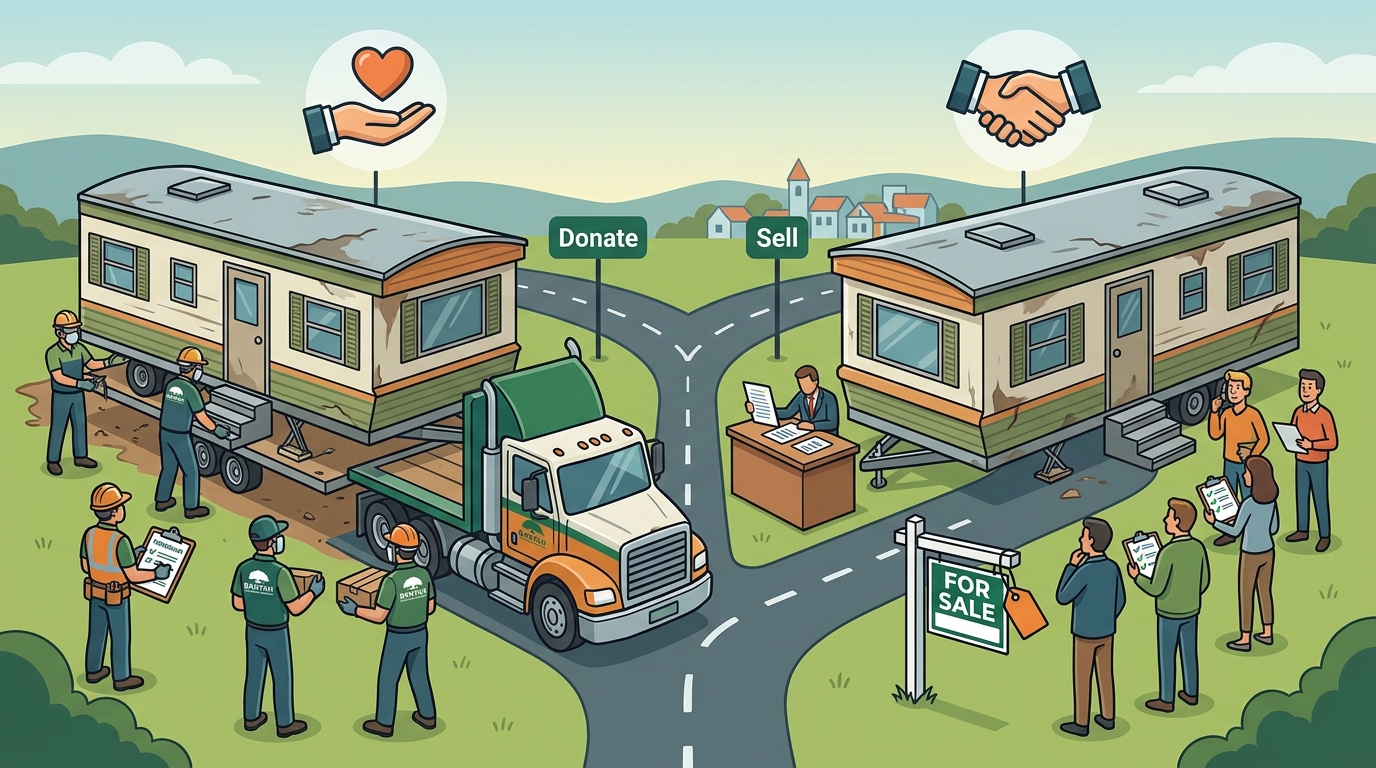
The following table summarizes the key differences between donating and selling your mobile home. This comparison highlights the trade-offs between financial gain, speed, and ease of process.
| Factor | Selling Your Mobile Home | Donating Your Mobile Home |
|---|---|---|
| Primary Benefit | Immediate cash payment | Charitable tax deduction |
| Speed of Removal | Slow (weeks to months) | Fast (typically within 8 weeks) |
| Condition Requirements | Must be marketable and repairable | Must be 1980+ and structurally sound for transport |
| Cost to Owner | Agent fees, staging, repairs | Free removal (no cost to owner) |
| Liability | Remains until sale closes | Transferred to nonprofit upon acceptance |
| Best For | Homes in excellent condition with high value | Homes needing removal, tax benefits, or affordable housing support |
Key Takeaways
- Financial Strategy: Selling provides cash, while donating provides tax deductions. For homes with low market value, the tax deduction often outweighs the cash offer.
- Speed: Donating through a specialized nonprofit is significantly faster than selling, with removal typically occurring within eight weeks.
- Eligibility: Homes must be 1980 or newer to qualify for donation through organizations like Banyan Mobile Home Removal.
- Liability: Donating transfers liability to the nonprofit immediately, reducing risk for the property owner.
- Cost: Donation removal is free to the owner, whereas selling involves agent fees and potential repair costs.
- Impact: Donating supports affordable housing initiatives, providing a home to a family in need.
- Process: Donation requires clear title and coordination with a licensed mover, which the nonprofit handles.
Frequently Asked Questions
Can I donate a mobile home that is in poor condition?
Yes, as long as the home is 1980 or newer and structurally sound enough to be moved, it can likely be donated. Nonprofits often repurpose homes that are not suitable for traditional resale.
How is the tax deduction calculated for a donated mobile home?
The deduction is based on the fair market value of the home at the time of donation. For values over $5,000, a qualified appraisal is required to determine the exact amount.
Do I have to pay for the removal of my donated mobile home?
No, accredited nonprofits like Banyan Mobile Home Removal cover the cost of removal entirely. You receive the home removed at no cost to you.
What if my mobile home title is extinguished?
If the home is considered part of the real estate, you may need to re-establish its vehicle title before donation. The nonprofit can guide you through this process.
How long does the donation process take?
Once the home qualifies, removal typically occurs within eight weeks. The timeline can vary based on mover availability and logistical factors.
Can I sell my mobile home if it has back taxes?
Selling a home with back taxes can be complicated, as liens must often be cleared before transfer. Donating may offer a simpler path to removal, though tax implications should be reviewed with a professional.
Is donating better than letting the home deteriorate?
Yes, donating removes liability and potential environmental hazards, whereas letting a home deteriorate can lead to fines and safety risks.
Next Steps
If you are ready to clear your land and make a positive impact, consider donating your mobile home. Banyan Mobile Home Removal offers a free, professional removal service for qualifying homes. Contact us today to start the qualification process and see how you can turn an unwanted asset into a charitable contribution.